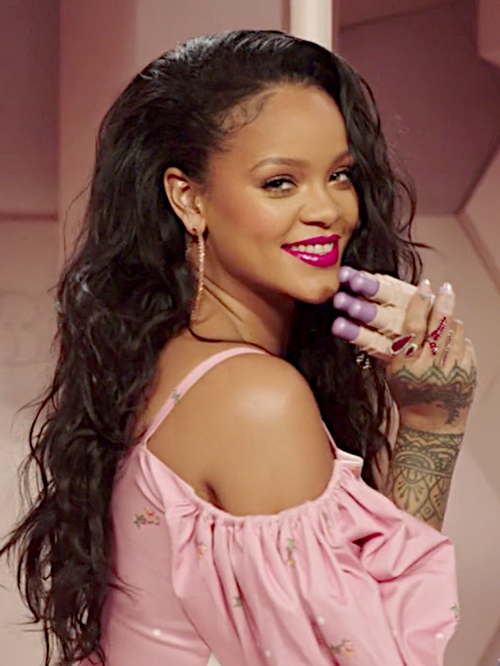
The transition from pop icon to business titan is a well-trodden path in the modern celebrity economy, but few have navigated it with the seismic impact of Robyn Rihanna Fenty. She didn't just slap her name on a product line; she engineered a market disruption so profound it fundamentally altered the landscape of luxury retail. Her journey from the stages of Barbados to the boardrooms of LVMH is not merely a success story—it’s a masterclass in leveraging authenticity to forge a multi-billion dollar empire.
For years, Rihanna was defined by her music: 14 number-one hits, 60 million albums sold worldwide, and a touring revenue stream that generated approximately $150 million. Her early career earnings, estimated around $260 million before her business ventures truly took off, already placed her among the financial elite of the music industry. Yet, the true financial supernova ignited in September 2017 with the launch of Fenty Beauty. This wasn't just another celebrity makeup line; it was a cultural reckoning. The brand’s immediate success was staggering, pulling in $100 million in sales within its first 40 days, a figure that signaled a massive, unaddressed consumer demand.
The genius of Fenty Beauty lay in its radical inclusivity. While established giants like Estée Lauder and L'Oréal offered limited shade ranges, Fenty Beauty launched with 40 foundation shades, quickly expanding to 50. This move, often dubbed the "Fenty Effect," forced the entire industry to diversify its offerings. Rihanna didn't just create makeup; she solved a long-ignored problem for millions of consumers. This authentic problem-solving, coupled with a strategic 50/50 joint venture with luxury conglomerate LVMH (Moët Hennessy Louis Vuitton), provided the necessary capital, distribution muscle, and luxury cachet. Today, Fenty Beauty is the crown jewel, contributing the bulk of the brand’s estimated $600 million in annual revenue, and valuing the entire operation at approximately $2.8 billion, making Rihanna's 50% stake alone worth around $1.4 billion.
But the empire building didn't stop at cosmetics. In 2018, Rihanna turned her disruptive gaze toward the stagnant lingerie market with Savage X Fenty. At a time when Victoria’s Secret was struggling with outdated marketing and limited sizing, Savage X Fenty offered a radical alternative. The brand embraced sizes ranging from XS to 4XL, utilizing spectacular, streamed fashion shows featuring models of all ethnicities, sizes, and genders. This inclusivity resonated powerfully, quickly establishing Savage X Fenty as a formidable competitor. While Rihanna holds a smaller, 30% stake in the company, its valuation soared to $1 billion. The brand currently pulls in an estimated $400 million in annual revenue, with aggressive retail expansion plans aiming for over 50 physical stores by 2026.
The Fenty ecosystem is rounded out by Fenty Skin, which launched successfully and now contributes an estimated $150 million annually. What distinguishes Rihanna from other celebrity entrepreneurs—many of whom, like Jessica Alba or Gwyneth Paltrow, have built successful brands—is the sheer speed and scale of her luxury market penetration, backed by the strategic partnership with LVMH. This partnership is crucial; it’s the difference between a successful celebrity endorsement and a globally distributed, luxury-positioned powerhouse.
Beyond her business ventures, Rihanna’s financial acumen is reflected in her substantial real estate portfolio, valued at approximately $50 million, including a $13.8 million mansion in Beverly Hills and multiple properties in her native Barbados. These assets provide a stable foundation beneath the volatile world of fashion and beauty.
The question now isn't whether Rihanna can sustain her success, but how high she can push the valuation. With Fenty Beauty continuing to innovate and Savage X Fenty capturing market share, speculation often turns to a potential IPO for the lingerie line, a move that could unlock hundreds of millions more in liquidity. As the first female musician to achieve billionaire status, largely through entrepreneurial endeavors rather than touring or endorsements, Rihanna has set a new benchmark. She proved that the most successful celebrity brands are those built not just on fame, but on addressing genuine market deficiencies. Her empire is a testament to the fact that authenticity, when paired with strategic luxury partnership and consistent innovation, is the ultimate currency in the 21st-century global market.