
When analyzing the architecture of modern celebrity wealth, few pairings offer a starker contrast than Serena Williams and Elon Musk. Both have achieved stratospheric levels of financial success and global influence, yet their paths to accumulating capital and their underlying risk profiles are fundamentally different. Williams built her empire on personal performance, brand equity, and diversified, minority investments, while Musk's fortune is almost entirely predicated on majority ownership in volatile, publicly traded technology companies.
Williams’ initial wealth engine was her unparalleled dominance in professional tennis. This model, common among elite athletes, relies on maximizing earnings during a finite competitive window. Her income streams were highly visible: prize money, which is significant but capped, and massive endorsement deals. These endorsements, with brands like Nike and Gatorade, monetized her personal brand—an asset that appreciates through sustained excellence and global recognition.
The sustainability of the Williams model hinges on influence. Even after stepping away from professional competition, her brand equity remains incredibly high, allowing her to transition seamlessly into venture capital and board roles. Her firm, Serena Ventures, manages a portfolio of over 60 companies. This approach favors diversification and lower individual risk, essentially leveraging her fame as a powerful, non-dilutive marketing tool for her investments.
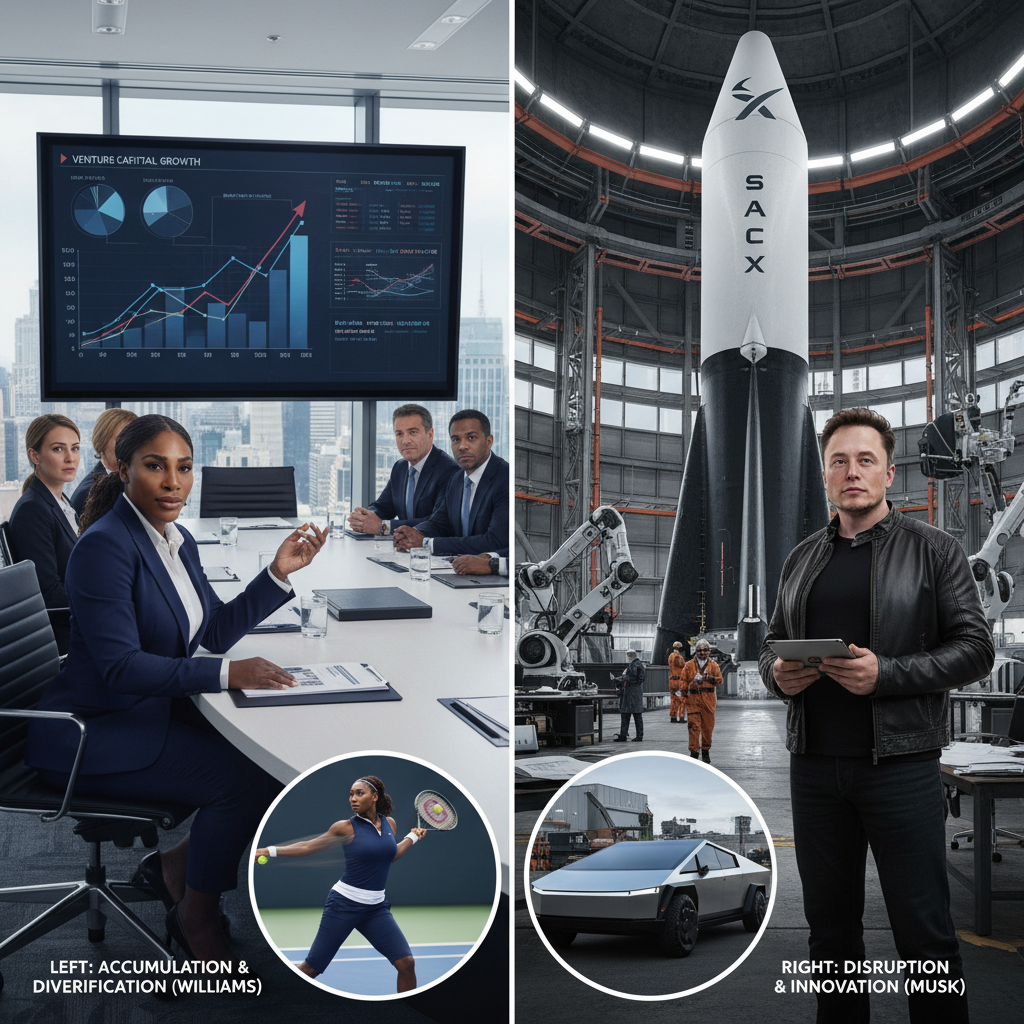
In contrast, Elon Musk’s wealth accumulation model is the definition of the equity vortex. His fortune is overwhelmingly concentrated in shares of Tesla, SpaceX, and, more recently, X (formerly Twitter). Unlike Williams, whose capital was earned through performance and endorsements, Musk’s wealth is largely derived from founding companies and maintaining massive equity stakes, which are valued based on future, often aggressive, growth projections.
This difference creates fundamentally distinct risk profiles. Williams faces market risk common to venture capital, but her core capital is protected and diversified. Musk, conversely, faces extreme concentration risk. A significant downturn in the valuation of Tesla, driven by regulatory changes, market sentiment, or production issues, can wipe billions off his net worth almost instantaneously. His wealth is highly liquid on paper but often illiquid in practice due to the sheer volume of shares he holds and the tax implications of selling them.
The athlete monetizes the present influence derived from past performance; the entrepreneur monetizes the future value derived from perceived innovation.
Musk’s influence is tied directly to the performance and ambition of his companies. When SpaceX achieves a milestone or Tesla releases promising delivery numbers, his influence and net worth surge. His public persona is an extension of his corporate strategy, often used to drive narratives, manage stock prices, and recruit talent. This tight linkage means his personal brand is inseparable from his corporate risk.
Serena Williams’ monetization strategy, particularly through endorsements and Serena Ventures, is about partnerships. She lends her credibility and capital to existing structures, taking minority stakes and leveraging her network. This is a high-margin, low-overhead model where the primary input is her time and reputation. She is a powerful catalyst, but not the sole operational driver.
The scale of their respective operations also dictates their required public engagement. Williams can choose when and where to deploy her influence, often focusing on social impact or specific investment rounds. Her public influence is an asset she controls. Musk, however, must constantly engage with the public, regulators, and media to maintain the high valuation multiples required to sustain his wealth. His influence is a necessary operational tool, not just a branding exercise.
The long-term sustainability of the two models also diverges. Williams has successfully transitioned from an active performer to a capital allocator. Her wealth architecture is built to outlast her professional career, focusing on passive income generation and portfolio growth. The foundation is solid, built upon decades of guaranteed income streams and prize money that have already been realized and invested.
Musk’s sustainability depends on continuous, transformative innovation. His companies must consistently meet or exceed market expectations for exponential growth. While this model offers the potential for unprecedented scale, it carries the inherent risk that technological obsolescence or failure to deliver on ambitious projects—like full self-driving or Mars colonization—could dramatically deflate valuations.
Furthermore, their approaches to capital deployment reflect their origins. Williams, coming from a highly competitive, individual sport, focuses on precision, timing, and calculated risk in her investments—often backing founders who reflect her values or address market gaps she identifies. Her capital is deployed strategically, seeking outsized returns through careful selection.
Musk, the engineer and founder, deploys capital primarily to fuel massive, capital-intensive industrial projects. His investments are less about diversification and more about vertical integration and achieving technological dominance in specific sectors. He is constantly reinvesting potential profits back into R&D and expansion, prioritizing growth and market share over immediate shareholder dividends, which is characteristic of high-growth tech founders.
In essence, Williams built an Influence Dividend model: leveraging her hard-won global reputation to secure favorable deals and drive portfolio success. Her net worth is robust and insulated. Musk operates under the Equity Vortex: his wealth is a direct measure of market belief in his ability to execute revolutionary, high-stakes technological visions. While both are billionaires, Williams’ structure emphasizes preservation and calculated growth, whereas Musk’s is defined by concentration and the relentless pursuit of exponential scale.
--- ## Image Credit *To be added by editor: Upload images and add source attribution here.*