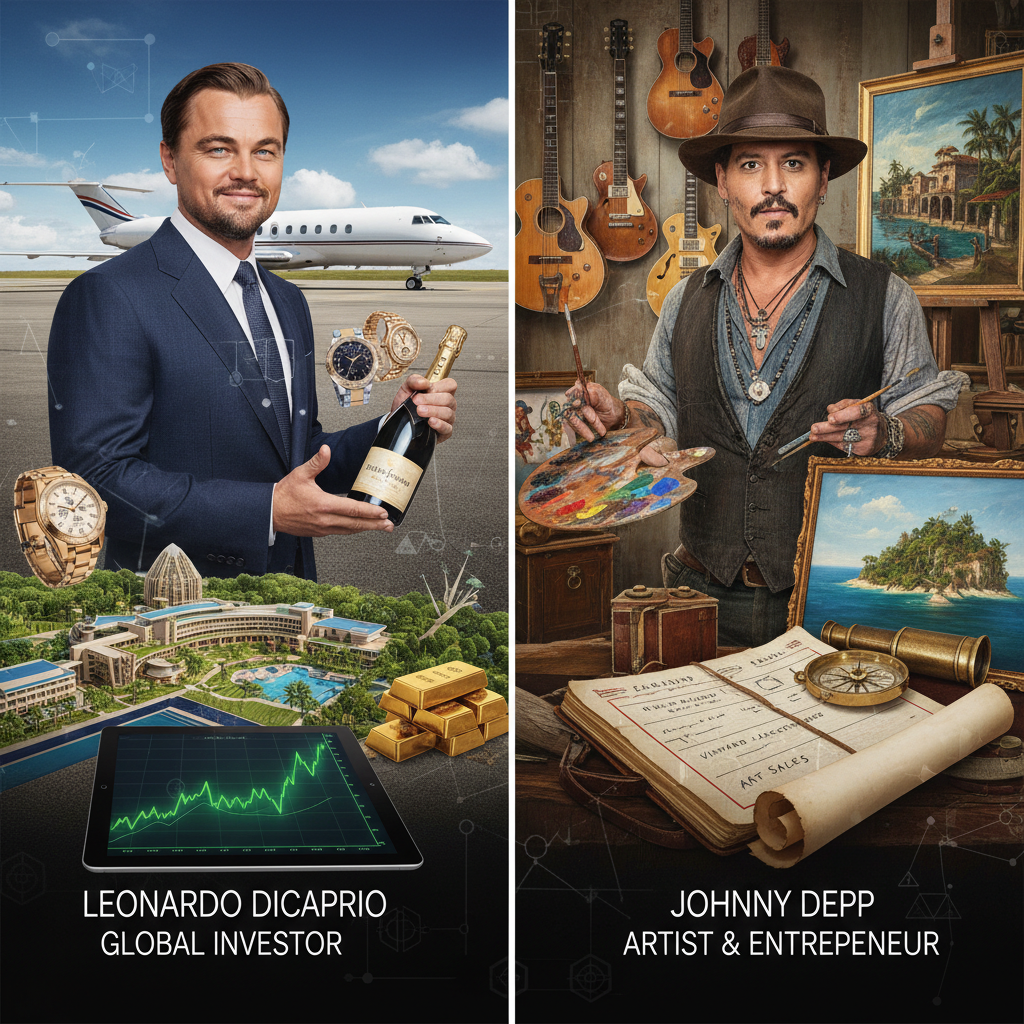
Wealth, influence, and the diverging paths of Leonardo DiCaprio and Johnny Depp
Friday, January 30, 2026
# The Blue Chip Icon vs. The Bohemian Mogul: Deconstructing the Billion-Dollar Risk Profiles of DiCaprio and Depp
***
### Wealth & Influence Snapshot: DiCaprio vs. Depp
* **DiCaprio (LD):** The "Blue Chip" actor; wealth model relies on selective, prestige projects, significant backend equity, and strategic brand alignment, emphasizing long-term sustainability and environmental advocacy.
* **Depp (JD):** The "Bohemian Mogul"; wealth historically driven by massive franchise payouts (Pirates) and high-volume, high-fee contracts, offset by notoriously high burn rates and significant legal/personal volatility.
* **The Key Contrast:** LD prioritizes *optionality* and *legacy* over sheer volume, maintaining a tightly controlled public image; JD’s financial narrative is defined by *peak earnings* followed by dramatic *risk exposure* and public spectacle.
* **Long-Term Outlook:** LD’s portfolio and career trajectory suggest compounding, stable growth; JD faces the ongoing challenge of rebuilding brand trust and stabilizing highly leveraged personal finances.
***
The financial narratives of Hollywood’s leading men often serve as compelling case studies in wealth management, risk tolerance, and the delicate dance between art and commerce. Few comparisons offer such a stark contrast in strategy and sustainability as that between Leonardo DiCaprio and Johnny Depp. While both actors achieved stratospheric levels of fame and earning power in the late 1990s and 2000s, their approaches to converting cultural capital into durable financial empires diverge dramatically—one built on meticulous control and brand purity, the other defined by explosive earnings and equally explosive expenditures.
DiCaprio, the perennial Oscar contender, has cultivated a career that mirrors a highly selective, blue-chip investment portfolio. His strategy is defined by scarcity. Since the early 2000s, LD has consistently worked with a handful of A-list directors—Scorsese, Tarantino, Iñárritu—choosing projects that guarantee critical acclaim and global distribution. This selectivity is not merely artistic; it is a profound financial decision. By limiting his output to one major film every two to three years, he drives up his market value and, crucially, his negotiation leverage. Industry reports suggest that for major studio pictures, DiCaprio often foregoes a massive upfront salary in favor of significant backend participation, sometimes securing 20% or more of the gross box office receipts after break-even. This model transforms him from a mere hired talent into a profit partner, aligning his financial success directly with the film’s performance—a strategy that paid immense dividends on projects like *Inception* and *The Wolf of Wall Street*.
Depp’s path to peak earnings, conversely, was built on the foundation of the *Pirates of the Caribbean* franchise. His portrayal of Captain Jack Sparrow became a global merchandising juggernaut, allowing him to command salaries that, at their zenith, reportedly touched $50 million per film. This was a volume-based wealth model, predicated on the reliable, recurring revenue stream of a massive Disney IP. However, where DiCaprio’s earnings were often reinvested into his production company, Appian Way, and strategically aligned environmental ventures, Depp’s financial structure was characterized by extraordinary liquidity demands. The infamous details revealed during his legal battles painted a picture of a celebrity operating with a staggering burn rate—allegedly spending millions monthly on personal staff, properties, art, and highly specific luxury items, including a reported $30,000 per month on wine alone. This high-velocity spending meant that even his massive earnings were highly susceptible to market downturns or, more critically, career disruption.
The difference in their risk profiles is perhaps the most telling aspect of their financial sustainability. DiCaprio’s brand is meticulously curated, focusing heavily on his environmental activism. This advocacy serves a dual purpose: it provides a stable, positive narrative that transcends Hollywood gossip, and it positions him as a high-integrity partner for corporate endorsements and investments in the burgeoning ESG (Environmental, Social, and Governance) sector. His production company, Appian Way, has quietly expanded into documentary production and sustainable technology investment, diversifying his income streams away from relying solely on his acting fees. His public image is a fortress, designed to minimize exposure to personal scandal, thereby protecting his long-term earning potential.
Depp’s risk profile, unfortunately, proved to be highly leveraged against his personal life. The public and protracted legal disputes effectively created a massive, uninsurable liability for studios. While his talent was undeniable, his personal volatility and the subsequent loss of key roles—most notably the *Fantastic Beasts* franchise—demonstrated the catastrophic financial consequences when a celebrity’s personal brand collapses. The loss of guaranteed franchise income, coupled with the need to fund extensive legal defense, created a severe liquidity crunch, forcing him into a period of financial and career reconstruction.
Monetization strategies also highlight the divergence. DiCaprio is exceptionally selective regarding endorsements, preferring to align with luxury brands (like Rolex) or sustainable initiatives that reinforce his established persona. These partnerships are typically long-term and high-value, emphasizing prestige over ubiquity. Depp, while having had lucrative fragrance deals (Dior Sauvage), often relied more heavily on the guaranteed, immediate cash flow from film roles. Following his legal victory, his monetization strategy has shifted, focusing heavily on art sales. His limited-edition prints, often fetching high six figures, represent a direct-to-consumer wealth model that bypasses the traditional Hollywood gatekeepers, capitalizing on his dedicated fanbase's loyalty and his newly re-established cultural relevance. This pivot is a fascinating example of a celebrity transforming personal notoriety into tangible, high-margin artistic assets.
In terms of influence, DiCaprio wields soft power. His influence is channeled through policy, philanthropy, and his ability to greenlight projects that align with his worldview. He is a power broker in the environmental movement, capable of mobilizing significant capital and political attention. Depp’s influence, post-scandal, is more tribal. It is deeply rooted in the loyalty of his core fanbase, who view him as a victim of media overreach. This influence is potent for direct-to-fan monetization (like art or music tours) but remains a harder sell for risk-averse, global corporate partners looking for universal appeal.
The long-term sustainability of their wealth models tells the final story. DiCaprio’s model is designed for generational wealth. By prioritizing equity stakes, owning valuable real estate (including a private island that reportedly operates on sustainable principles), and maintaining a pristine professional reputation, his financial engine is built to compound regardless of his future acting output. He has successfully transitioned from A-list actor to institutional investor and producer.
Depp, while demonstrating a remarkable comeback, faces a more complex financial future. His current strategy relies heavily on the continued enthusiasm of his base and the success of non-traditional revenue streams (art, music). While his brand has stabilized, the sheer scale of his past financial liabilities and the need to maintain a disciplined approach to spending mean that his wealth accumulation must now prioritize debt reduction and stabilization over rapid expansion. The ultimate contrast lies in their approach to control: DiCaprio mastered control over his narrative and output; Depp, the bohemian, allowed his narrative to be dictated by external forces, creating a high-stakes financial drama that continues to unfold.
Ultimately, both men represent peak earning potential within the entertainment industry, but their careers serve as cautionary tales and models for future stars. DiCaprio proves that scarcity, strategic alignment, and meticulous brand management are the cornerstones of enduring financial power. Depp demonstrates the exhilarating, yet dangerous, volatility inherent in relying on massive, short-term cash flows without corresponding financial discipline and robust personal risk mitigation. Their balance sheets are not just ledgers of income, but maps of their lives—one a study in precision engineering, the other a masterpiece of chaotic genius.
---
## Image Credit
*To be added by editor: Upload images and add source attribution here.*
---
## Image Credit
*To be added by editor: Upload images and add source attribution here.*